

How do “luxury-budget” hotels manage to ruin breakfast?
How can, sometimes, a coffee and a croissant at an Agriturismo or a modest breakfast from a host running a private bed and breakfast be more satisfying than the limitless choice at certain 4-star, or even 5-star hotels?
By forgetting the oldest rule in food (and make-up alike): less is more.
As a self-declared, self-certified wanderer and muncher, I would like to finally write a manifesto about an issue that bothers me a little too often lately, essentially almost after each holiday… There is a peculiar disease affecting hotel breakfasts: the belief that luxury can be measured by the number of things placed on a buffet.
Twenty-seven types of cereal, six cheeses, five kinds of pastries, several mysterious hot dishes, fruit arranged into architectural structures, salads nobody touches… Something vaguely Mediterranean… Something vaguely Asian. Something that is probably local, but has been so aggressively modernised that nobody can identify it anymore. A banquet and a fourchette in one.
And somewhere in the middle of all this abundance, I, the tired guest, am looking for four things: bacon, the humble eggs, hot coffee, and good ol’ fresh orange (or apple) juice.
This was particularly apparent to me during my last year’s holiday in Serbia, where I encountered exactly this phenomenon: an impressive breakfast buffet which somehow managed to be less satisfying than a much more modest breakfast elsewhere.
Because the problem with breakfast isn’t usually lack of choice. It is that hotels sometimes forget what the guest actually came there for.
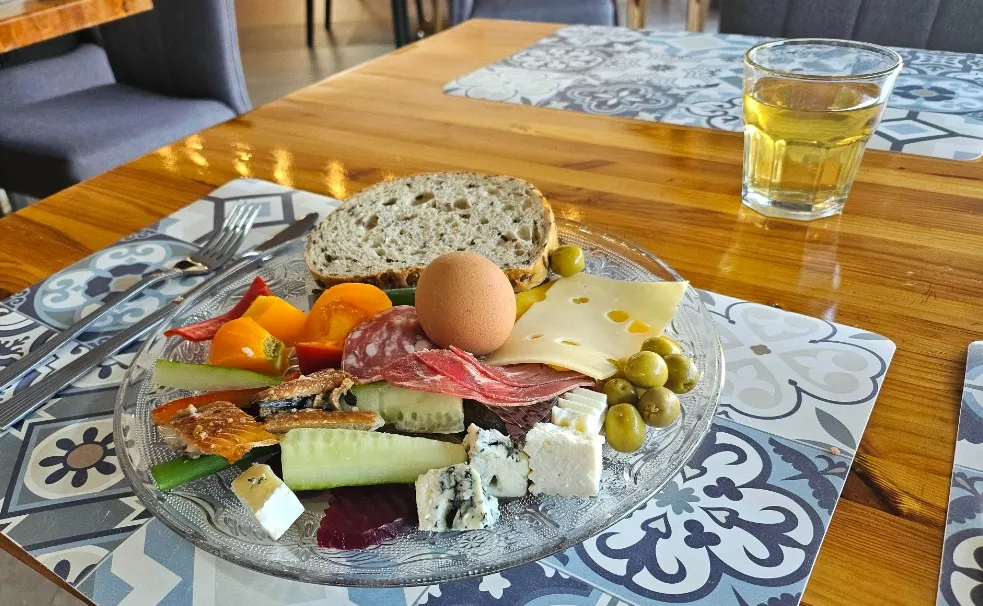
The five-year-old test
If I were to advise hotel and restaurant owners, I would tell them the following. Imagine that your guests are a bunch of fussy five-year-olds. Not literally, obviously. Although sometimes I suspect hotel breakfast designers would benefit from this exercise.
What will the five-year-olds look for first?
The familiar things, which should also be good. Not just technically present… Good.
The basics are not bonuses, but rather absolute prerequisites.
You can have the most spectacular buffet in the world, but if your bacon is cold, your coffee is bad and your orange juice tastes like a concoction of chemicals masquerading as juice, you have already failed.
My number-one action at breakfast is to taste the orange juice. If it is bad, my rating automatically goes from five stars to four stars, regardless of how rich the buffet actually is.
You failed at providing the basics.
If the juice is a concoction of chemicals, then we have a case of:
“It’s over. It never began.”
My immediate thought becomes:
Ok, another shithole that thinks it’s a luxury hotel simply because they hired a designer.
And this is perhaps unfair. However, it is also how consumers work. We don’t evaluate every element of a breakfast independently, calculate some weighted average and conclude that the hotel scored 8.7/10. We notice certain things. And some things become proxies for the entire establishment.
Luxury is not abundance
There is a difference between having more and experiencing more. A buffet overflowing with food looks luxurious. Nonetheless, the experience of eating it can be decidedly un-luxurious if half of it is mediocre.
Not keeping food constantly hot is another classic mistake. A beautifully prepared dish can sit under inadequate heating for long enough to become dry, greasy, leathery…And generally sad.
The guest doesn’t think:
Interesting. There appears to have been some degradation in texture and flavour due to prolonged holding.
They think:
“Why is this shit cold?”
And they remember it. This is where hotels sometimes confuse the production of food with the experience of food. The guest doesn’t care how impressive your kitchen looked at 6:30 in the morning. They care about what happens when the fork reaches their mouth at 9:15.
Please don’t be embarrassed by your own quirky food
This is another thing hotels sometimes get spectacularly wrong. If you are serving national cuisine, tell people that it is national cuisine. Present it as an invitation and as an exploratory food journey.
Don’t assume that because something is boring to you, it is boring to your guest.
A filo pie may be something your grandmother makes every Sunday and that you have eaten approximately 14578 times. To a foreign traveller it may be one of the most interesting things on the entire buffet.
Your ordinary food is precisely what your foreign guest has travelled to experience.
There is something slightly tragic about travelling to another country and being offered the same anonymous international breakfast you could have eaten in Birmingham, Berlin or Bucharest.
I don’t need another croissant.
I want to know what you eat. Give me the filo pie. Tell me what it is…Maybe even attach a label telling me its history. Tell me where it comes from and make me curious enough to try it.
And if it is good, I will probably remember it much longer than your seventh variety of industrial pastry.
The hierarchy of breakfast
And this is where the order matters. First, give me the things I already know I want. And make them good…Fresh juice, good coffee, eggs, bacon at the right temperature, sausages, flavoursome tomatoes…Fresh vegetables…Yoghurt…Cereals.
Then give me something I don’t know…Something local…Strange…Something I wouldn’t have ordered at home. That is where the fun begins.
You don’t ask someone to go on a culinary adventure before you have established that they can trust you. The basic breakfast is the psychological safety net during our geographic explorations. Once I know the coffee is good and the bacon isn’t cold, I start trusting your chef and I can become adventurous.
I can try your mysterious Serbian pastry. I can investigate the strange cheese. I can eat something that looks like it was invented by somebody’s grandmother rather than a multinational food company. And I might love it.
The breakfast room matters too
Then there is the space itself. The breakfast area should be cosy, welcoming and pleasant. A place where you actually want to sit for half an hour rather than a brightly lit food warehouse where 120 people are simultaneously fighting over scrambled eggs.
This is not decoration for decoration’s sake. The environment is part of the experience of eating. Hire a professional who can make it such…And no, the owner’s wife who took a course online is not a professional (though she may be talented).
Because we are spoiled…And we like to travel…And we like to eat…And sometimes breakfast is the first real impression we get of a place in the morning.
A bad breakfast can sometimes make or break the day. Which brings back to the opening question of this rant…I mean…Manifesto.
Why can a coffee and a croissant at a modest agroturismo, or breakfast prepared by a little B&B owner, sometimes be more satisfying than the limitless choice offered by a four-star or even five-star hotel?
Because the little place isn’t necessarily giving you more. It may be giving you less…In fact, in most cases, they are giving you less.
However perhaps their coffee is excellent…The croissant is fresh. The orange juice is actually orange juice. The tomatoes taste like tomatoes. The owner knows where the eggs came from.
And somebody has thought about what you are actually going to experience rather than simply how impressive the buffet will look in the photographs.
That, to me, is the difference between abundance and hospitality.
A luxury breakfast doesn’t need to make me feel that I have entered a food warehouse. It needs to make me feel that somebody cared.
Less, but better.
And please…Keep the hot food hot.